PostgreSQL vs MySQL for New Projects in 2026: Which Database Should You Choose?
A practical, in-depth comparison of PostgreSQL vs MySQL for new projects in 2026. Learn which database is better for startups, SaaS apps, web development, performance, JSON support, scaling, and long-term growth before you choose your tech stack.
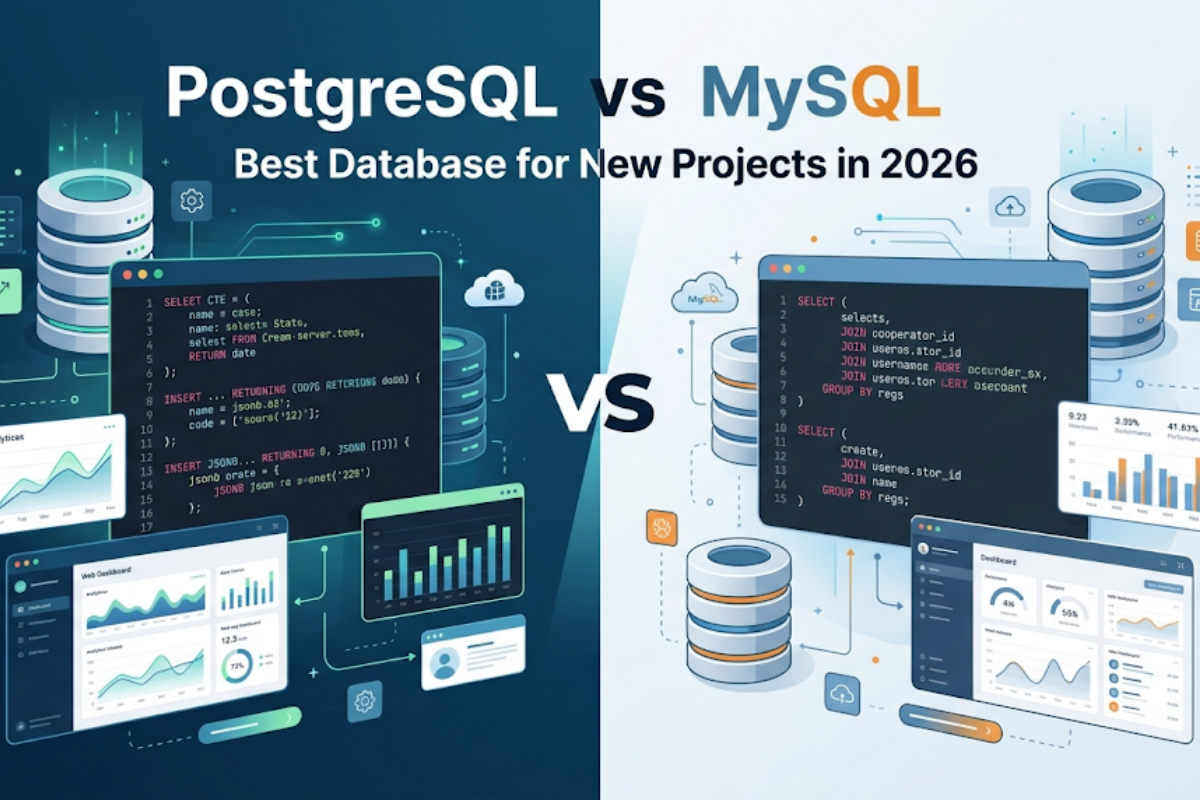
If you are starting a new project in 2026, there is a good chance your database shortlist still comes down to two names: PostgreSQL and MySQL.
That makes sense. Both are mature, battle-tested relational databases. Both power serious production systems. Both have huge communities, broad hosting support, and enough tutorials to keep you busy for a year. But that surface-level similarity is exactly why teams make the wrong decision. They assume these databases are interchangeable, pick the one they have heard of more often, and only later discover that their actual product needs a different fit.
Here is the short answer after looking at the current 2026 landscape: PostgreSQL is the better default for most new projects, especially if you expect complex queries, growing product requirements, richer JSON usage, stricter data integrity, or a modern SaaS-style architecture. MySQL is still a strong choice for simpler CRUD applications, read-heavy websites, teams with existing MySQL expertise, and environments where operational familiarity matters more than feature depth. PostgreSQL 18 added notable improvements like asynchronous I/O, skip scan, virtual generated columns, and temporal constraints, while MySQL 8.4 is the current long-term support line and MySQL 8.0 is scheduled to reach end of life in April 2026.
This topic also has real search demand right now. Your Google Trends screenshot shows that interest in “postgresql vs mysql” stays steady over time with a visible spike heading into 2026, which lines up with version changes and upgrade decisions. That matters because it tells you this is not just a random dev argument. It is an active buying and architecture decision.
PostgreSQL vs MySQL quick comparison
| Category | PostgreSQL | MySQL |
| Best for | Complex apps, SaaS, analytics-heavy products, extensibility | Simpler web apps, read-heavy sites, teams with MySQL experience |
| Current major line | PostgreSQL 18 | MySQL 8.4 LTS |
| JSON support | json, jsonb, jsonpath, rich operators/functions | Native JSON type, JSON functions, indexing often via generated columns |
| Full-text search | Built-in full-text search with indexing and ranking tools | FULLTEXT indexes for InnoDB/MyISAM, with some restrictions |
| Replication | Physical and logical replication | Source-replica replication and Group Replication |
| Extensibility | Strong extension model | More conservative feature surface |
| Default pick for new projects | Usually yes | Sometimes, depending on workload and team |
This table hides an important truth: the biggest difference is not speed on a benchmark chart. It is how much room your database gives you when the application becomes more complicated than you expected. PostgreSQL is designed to be highly extensible, with extensions able to act like built-in features, while MySQL tends to feel more opinionated and narrower in scope. PostgreSQL also ships with built-in full-text search and rich JSON support via jsonb, while MySQL supports a native JSON type and JSON functions, but its own documentation still points to generated columns as a workaround in some indexing scenarios.
Why this choice matters more in 2026
The “just pick any SQL database” advice is lazy in 2026.
Why? Because modern applications do not stay simple for long. A new product may start as a clean relational schema, then quickly add audit logs, event streams, search, analytics dashboards, flexible metadata, role-based permissions, integrations, and semi-structured payloads from external APIs. Once that happens, your database stops being a storage layer and starts becoming part of your product strategy.
That is one reason PostgreSQL’s momentum matters. JetBrains’ 2025 Developer Ecosystem report says PostgreSQL edged out MySQL as the most popular database among surveyed developers, while the 2025 Stack Overflow Developer Survey shows PostgreSQL used by 55.6% of respondents compared with 40.5% for MySQL. At the same time, DB-Engines’ March 2026 ranking still places MySQL above PostgreSQL in overall popularity. The result is a useful split: PostgreSQL currently has stronger developer mindshare, while MySQL still has a larger overall footprint and installed base.
That split explains a lot of real-world behavior. New greenfield projects and developer-led products increasingly lean PostgreSQL. Legacy stacks, commodity hosting setups, and teams built around older LAMP-style habits still lean MySQL.
PostgreSQL 18 vs MySQL 8.4: what changed
If you are making this decision in 2026, version timing matters.
PostgreSQL 18 introduced an asynchronous I/O subsystem that can improve sequential scans, bitmap heap scans, vacuums, and related operations. It also added skip scan support for more multicolumn B-tree index cases, virtual generated columns, OAuth authentication support, and temporal constraints for primary key, unique, and foreign key rules over ranges. Those are not cosmetic changes. They improve performance, indexing flexibility, and schema design for serious applications.
MySQL’s current supported long-term line is 8.4, and Oracle’s MySQL documentation centers that version. Oracle also states that MySQL 8.0 will reach end of life in April 2026 and recommends moving to 8.4 LTS ahead of that date. In practice, this means one important thing for new projects: if you choose MySQL in 2026, you should be thinking in MySQL 8.4 terms, not 8.0 terms.
That timing slightly favors PostgreSQL for new builds because PostgreSQL 18 feels like a forward-looking release with several practical developer wins, while the MySQL story in 2026 is partly about getting people off 8.0 and onto the long-term branch.
PostgreSQL vs MySQL performance: which is faster?
This is the most common question and also the most misleading one.
For simple reads, straightforward CRUD apps, and common web workloads, MySQL can still feel very fast and very predictable. If your application mostly inserts rows, fetches rows by indexed keys, and renders pages, MySQL is not going to hold you back.
But “which is faster” is the wrong question for most modern projects. The better question is: which database performs better when the product gets complicated? That is where PostgreSQL usually starts to pull ahead. PostgreSQL is traditionally stronger for more advanced queries, richer indexing strategies, and workloads where correctness, data modeling flexibility, and query sophistication matter as much as raw simple-read speed. PostgreSQL 18’s new asynchronous I/O and skip scan support strengthen that position further.
My hot take is this: if you are asking about raw speed without describing your workload, you are probably solving the wrong problem. Most startups do not fail because MySQL was 5% slower than PostgreSQL on a blog benchmark. They fail because their schema, indexing strategy, and query model stopped matching the shape of the product.
PostgreSQL vs MySQL JSON support
This is one of the clearest reasons PostgreSQL is often the better default in 2026.
PostgreSQL supports both json and jsonb, and its documentation is very explicit that the practical difference is efficiency, with jsonb designed for better processing and querying. PostgreSQL also provides jsonpath, plus a large set of JSON functions and operators for extraction, transformation, and querying. That makes PostgreSQL a strong fit when your app has semi-structured fields, flexible metadata, webhook payloads, or API-driven schemas that are not perfectly relational.
MySQL also supports a native JSON data type and JSON functions, so this is not a case of “MySQL cannot do JSON.” It can. But MySQL’s documentation notes that generated columns are often used as a workaround for indexing JSON-derived values, especially in NDB-related documentation. MySQL also supports generated columns and secondary indexes on virtual generated columns, which helps, but it still feels less elegant than PostgreSQL’s overall JSON story.
If your product roadmap includes user-defined properties, API payload storage, dynamic settings, or “we need some flexible fields but we do not want to move to a document database,” PostgreSQL is usually the better bet.
PostgreSQL vs MySQL full-text search and search-like features
Search is one of those features teams underestimate.
PostgreSQL includes built-in full-text search with parsing, querying, ranking, and indexing support documented in its core manuals. This makes it surprisingly capable for many in-app search use cases, especially when you need search that is “good enough” without introducing an external search engine too early.
MySQL supports FULLTEXT indexes too, but there are tighter boundaries. The official docs say full-text indexes are supported only with InnoDB or MyISAM tables, only on CHAR, VARCHAR, or TEXT columns, and full-text searches are not supported for partitioned tables. That does not make MySQL bad here, but it does make PostgreSQL feel more comfortable when search requirements grow in weird directions.
If your product will likely need internal knowledge search, searchable notes, documentation-like content, or ranking beyond plain LIKE queries, PostgreSQL gives you a stronger base.
Replication, scaling, and production architecture
Both databases scale. They just do it differently.
PostgreSQL supports both physical streaming replication and logical replication. Its logical replication model gives fine-grained control over replicated data objects and changes, and PostgreSQL’s documentation highlights that it supports physical and logical mechanisms concurrently. That is useful when you want more selective replication behavior or more modern data-flow patterns across services.
MySQL supports traditional source-replica replication, which is asynchronous by default, and also offers Group Replication for highly available, fault-tolerant topologies. Group Replication can run in single-primary or multi-primary mode. That makes MySQL a very practical fit for teams that want conventional replication patterns and proven operational playbooks.
The practical difference is this: PostgreSQL often feels better when you want architectural flexibility. MySQL often feels better when you want operational familiarity and straightforward scale-out patterns.
Real-world decision scenarios
Let’s stop talking in abstracts.
Choose PostgreSQL if you are building:
- a SaaS app that will grow in complexity,
- a product with rich filtering, reporting, and analytics,
- a system with flexible metadata or JSON-heavy payloads,
- an app that may eventually need extensions or deeper database features,
- a product where data integrity and schema sophistication matter.
Choose MySQL if you are building:
- a simpler CRUD-style web app,
- a content-heavy or read-heavy website,
- a project where the team already knows MySQL deeply,
- a product running in an environment optimized around MySQL,
- an app where speed of familiar delivery matters more than feature depth.
That is the decision most teams should make. Not “which one is best in general,” but “which one will feel better after 12 months of real product growth?”
The startup answer: what I would choose for a new project
If I were advising a founder, indie hacker, or small product team starting fresh in 2026, I would say this:
Default to PostgreSQL unless you have a concrete reason to choose MySQL.
That recommendation is not ideological. It is practical. PostgreSQL’s current momentum among developers, strong JSON capabilities, built-in full-text search, extensibility, logical replication options, and new PostgreSQL 18 improvements make it the safer long-term default for most new software projects.
I would choose MySQL when one of three things is true:
- the team already knows MySQL very well,
- the product is intentionally simple,
- the hosting and ops environment strongly favors MySQL.
That is it. You do not get extra points for picking the cooler database. You get points for choosing the one that creates the least friction between your product and your future.
Common mistakes teams make
The biggest mistake is choosing based on habit.
A close second is choosing based on shallow benchmark arguments from blog posts that do not match your workload.
A third mistake is underestimating how often new products drift toward semi-structured data, more advanced filtering, reporting, search, and integration-heavy behavior. That drift is exactly why PostgreSQL keeps winning mindshare for greenfield projects. It gives teams more room before they hit architectural regret.
And one blunt warning: if you think “we will never need complex queries,” you are probably wrong.
Final verdict: PostgreSQL vs MySQL for new projects in 2026
Here is the clearest possible answer.
PostgreSQL is the better choice for most new projects in 2026. It is the stronger default because it handles growth, complexity, JSON-heavy patterns, search-like features, extensibility, and modern product requirements more gracefully. PostgreSQL 18 also gives it fresh momentum with meaningful improvements in performance and schema capabilities.
MySQL is still a great choice, but it is now more of a situational choice than a universal default. If your app is simpler, your team already knows MySQL, or your environment is built around it, MySQL 8.4 remains dependable and relevant. Just do not choose it by inertia. Choose it because it genuinely fits the project.
If you want the shortest possible conclusion, it is this:
Choose PostgreSQL for flexibility. Choose MySQL for familiarity. For most brand-new builds in 2026, flexibility wins.
FAQ: PostgreSQL vs MySQL
Is PostgreSQL better than MySQL in 2026?
For most new projects, yes. PostgreSQL currently offers a stronger default for complex applications, richer JSON support, extensibility, full-text search, and growing developer preference.
Is MySQL faster than PostgreSQL?
Sometimes for simpler workloads, but the better question is workload fit. PostgreSQL often becomes the stronger choice as query complexity and application requirements increase. PostgreSQL 18 also introduced performance-related improvements such as asynchronous I/O and skip scan.
Is PostgreSQL better for JSON?
Usually yes. PostgreSQL supports json, jsonb, jsonpath, and rich JSON operators and functions, which makes it especially strong for semi-structured application data.
Should I use MySQL or PostgreSQL for a startup MVP?
If the MVP is very simple and your team already knows MySQL, MySQL is fine. Otherwise, PostgreSQL is the safer long-term default because MVPs rarely stay simple for long.
Is MySQL 8.0 end of life?
Oracle says MySQL 8.0 will reach end of life in April 2026, and recommends upgrading to MySQL 8.4 LTS ahead of that deadline.
Continue reading more practical guides on the blog.